Supplier Spotlight: Kobayashi Casting Vietnam — Lost-Wax Investment Casting with Hardness Testing Inspection
April 5, 2026 · 8 min read
Part of our Supplier Spotlight series — real factory visits, real photos, no stock images. 179+ audited factories in the DEWIN Vietnam network.
179+
Audited Vietnam Factories
50-pt
Dolphin Audit Per Factory
1,700+
Real Factory Photos
Vietnam's manufacturing capability in precision castings is underestimated by most global buyers. Die casting gets the attention — but investment casting, the process that produces complex stainless steel impellers, carbon steel valve bodies, and precision structural components in alloys that can't be die cast, is equally well-developed in Vietnam's industrial base. The challenge is finding suppliers that combine technical capability with the process control discipline that international buyers require.
This is Supplier Spotlight #13 in our ongoing series — real site visits, real photos, no stock images, no anonymous network listings. Today: Kobayashi Casting Company Limited, a Vietnam-based investment casting factory with in-house wax injection machinery and hardness testing inspection, fully audited under DEWIN's 50-point Dolphin framework.
Previous spotlights: Bueno Technology (CNC), Altop (Die Casting), NAPEC (CNC + CMM), HDP (CNC + VMM), Minh Quang (Multi-Process), Eguchiseiko (Die Casting), Hirata (Japanese Machining), Huynh Duc (CNC + CMM), Lidovit (Fasteners), Ming Chuan (Injection Molding), Lac Hao (Multi-Process), Kinzoku (Cold Chamber Die Casting + CMM).
About Kobayashi Casting
Kobayashi (小林) is one of the most common Japanese family names. In Vietnam's industrial ecosystem, Japanese naming typically indicates a factory that was established with Japanese capital, operates under Japanese management methodology, or was developed to supply Japanese OEM customers — the Toyota, Honda, Panasonic, and Mitsubishi tier supply chains that have been rooted in Vietnam for two decades.
Kobayashi Casting specializes in investment casting — the lost-wax process that produces precision near-net shape castings in steel, stainless steel, alloy steel, and copper alloys. Their key differentiators from generic casting suppliers are:
- In-house wax injection machine — wax pattern dimensional accuracy controlled internally, not outsourced
- In-house hardness testing — material grade and heat treatment verification per lot without third-party lab dependency
- Japanese production methodology — structured process discipline, documented quality, organized facility management
- Full DEWIN Dolphin Audit pass — all 5 pillars verified on-site
Investment Casting: The Process and Its Advantages
Investment casting (lost-wax casting) is a precision casting process that builds a ceramic mold around a wax replica of the desired part, melts the wax out, and pours molten metal into the resulting ceramic cavity. The process enables:
The Lost-Wax Process — Step by Step
- Wax pattern injection — Wax injected into a metal die creates an exact part replica. Kobayashi does this in-house.
- Pattern assembly (tree) — Multiple wax patterns assembled on a central sprue system.
- Ceramic shell building — Wax tree dipped in ceramic slurry and coated with refractory material — repeated 5–15 times over several days.
- Dewaxing — Shell fired in autoclave or flash-fire furnace; wax melts out, leaving the ceramic cavity.
- Metal pour — Molten metal poured into the hot ceramic mold, filling the exact negative of the wax pattern.
- Shell removal & finishing — Ceramic shell broken away; parts cut from tree, inspected, and finished (heat treat, machining, surface treatment as required).
| Factor | Investment Casting | Die Casting | Sand Casting |
|---|---|---|---|
| Tolerance class | CT4–CT7 (tight) | CT4–CT6 (tight) | CT8–CT12 (loose) |
| Suitable alloys | Steel, stainless, alloy steel, copper | Aluminum, zinc, magnesium only | Any metal — lower precision |
| Internal passages | ✓ Excellent — complex geometry | ✗ Limited (cores difficult) | ~ Possible with sand cores |
| Surface finish (Ra µm) | 1.6–3.2 µm (near-net shape) | 0.8–1.6 µm | 6.3–25 µm (rough) |
| Min. order qty | Low–medium (50–500 pcs typical) | High (1,000–50,000+) | Very low (1–50 pcs) |
What We Saw on the Factory Visit
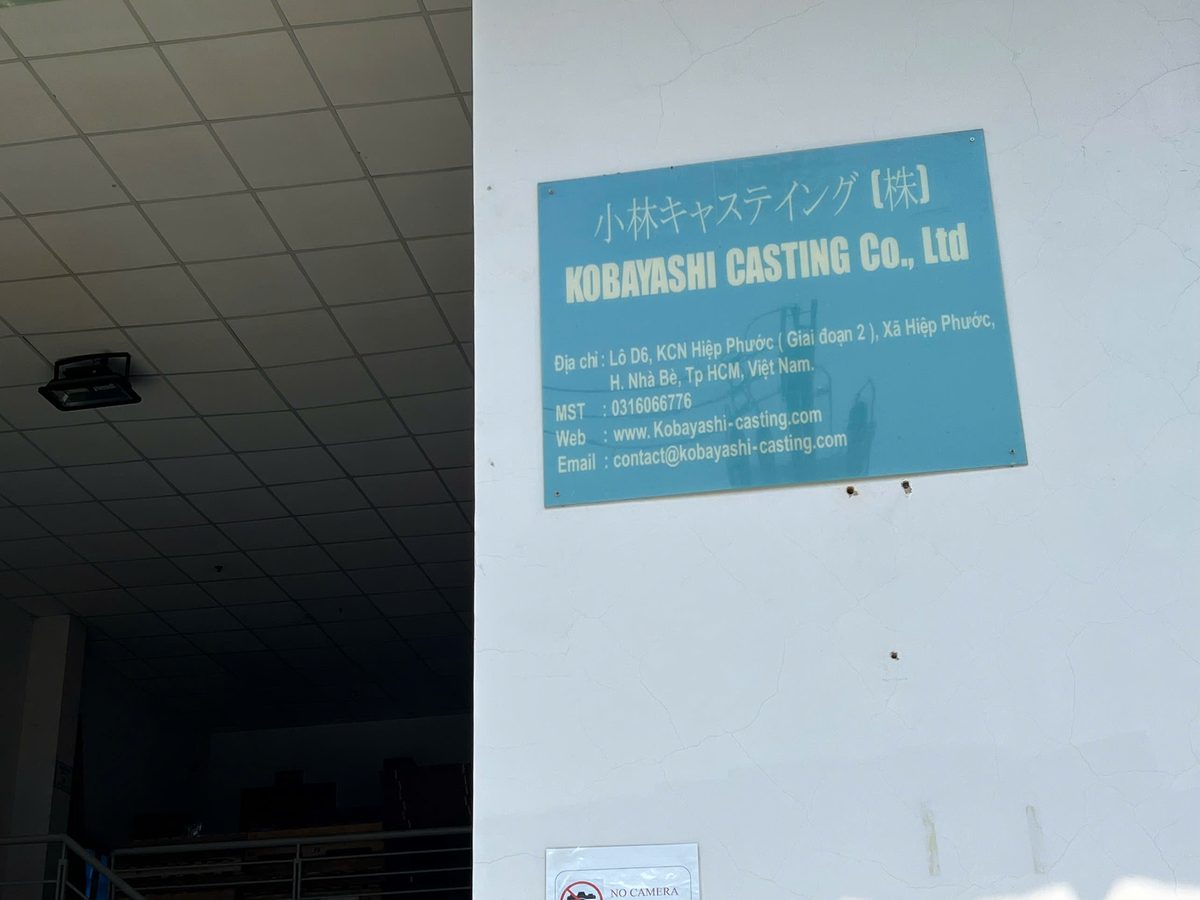
The factory gate and entry area present a well-defined facility perimeter with clear access control. Investment casting foundries that serve international customers typically maintain organized visitor-facing interfaces — international buyers expect visible evidence of systematic management at the facility level, not just the production floor.
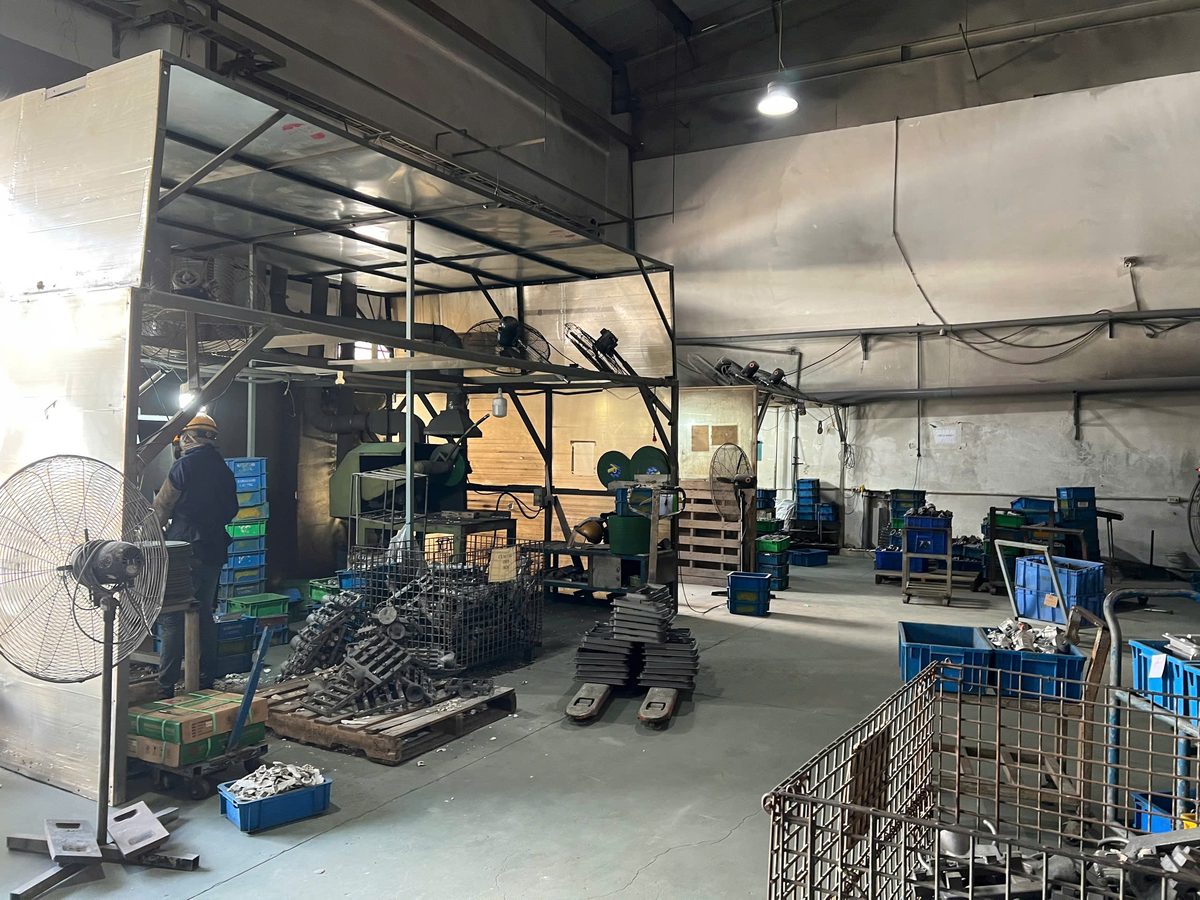
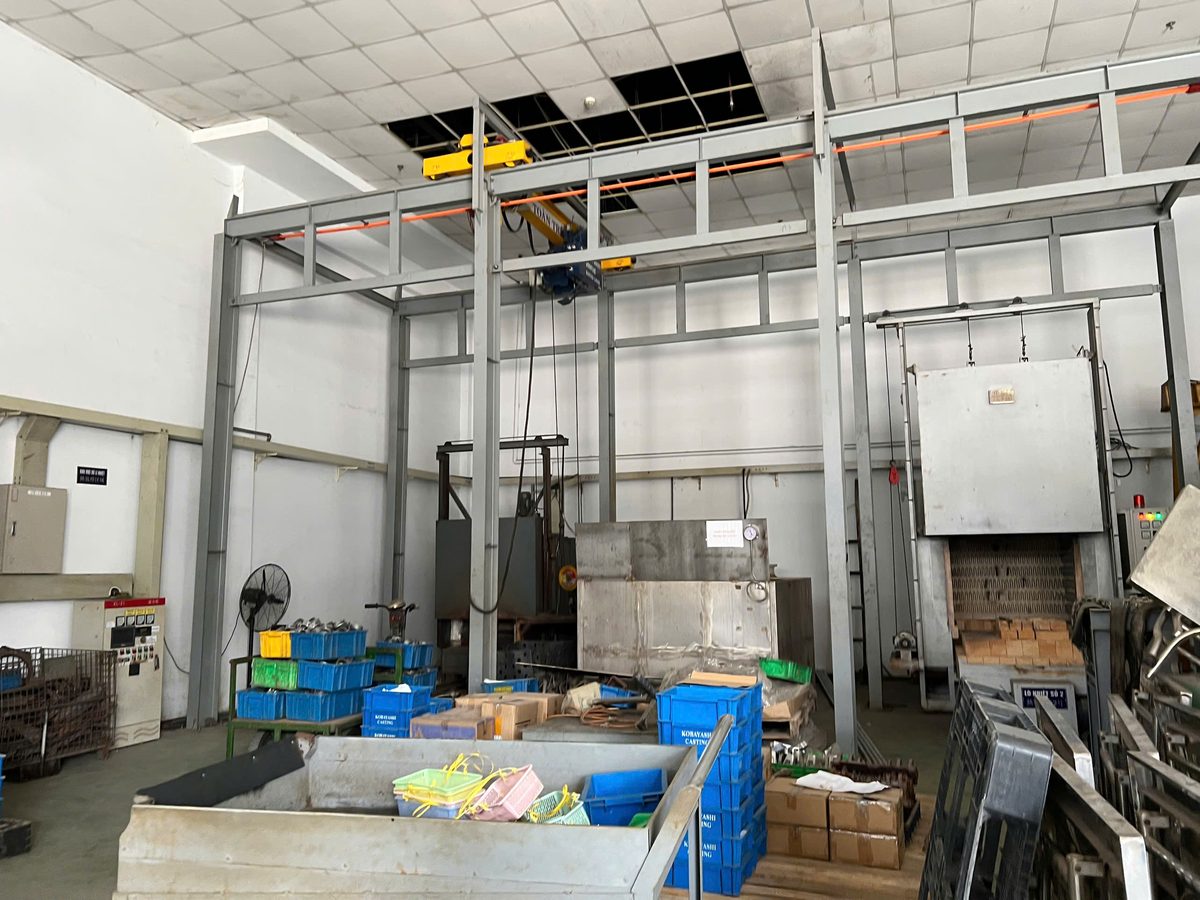
The main workshop and production area show characteristic zone separation for an investment casting operation: wax work, ceramic shell-building, furnace/pour, and finishing areas visibly distinct. The shelving, racking, and material organization visible in the workshop are consistent with a factory that manages multiple concurrent casting batches without mixing lot identities — a critical process discipline for traceability.
For global buyers accustomed to seeing online factory profile pages with clean stock photography, the real-visit photos from Kobayashi show what actual production looks like: organized, systematic, and scale-appropriate for the types of precision castings these factories produce.
In-House Wax Injection: Why It Matters for Casting Accuracy
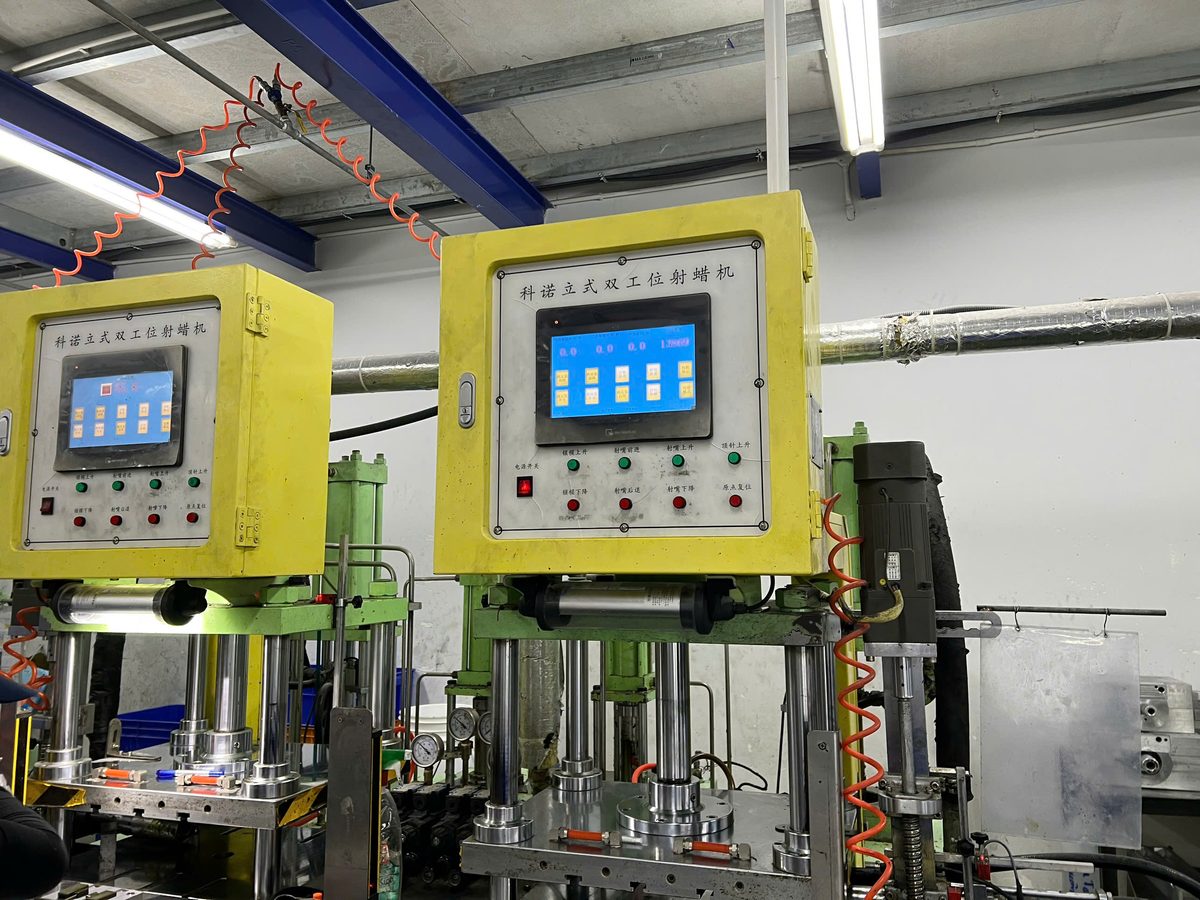
The wax injection machine is the starting point of the entire investment casting process — and it is where dimensional accuracy is either established or compromised. Every dimensional characteristic of the final casting begins as a characteristic of the wax pattern: every boss, passage, angle, and feature is defined in wax before the ceramic shell is ever built.
Factories that outsource wax pattern production introduce a process step they cannot audit, control, or verify. The wax sub-supplier may use different wax formulations, inconsistent injection parameters, or deteriorated dies — all of which produce dimensional variation that shows up in the final casting, often only discovered at first article inspection.
Kobayashi's in-house wax injection capability means:
- Wax material specification is controlled and documented
- Injection temperature and pressure parameters are set per part and logged
- Wax die condition is maintained in-house (shrinkage rate, tool wear)
- Pattern dimensional checks happen before the shell-building investment begins
For buyers sending new tooling to Vietnam for the first time, in-house wax control is the difference between first articles that arrive correct and first articles that require multiple re-shoots to get right.
Hardness Testing: Material Verification Built In
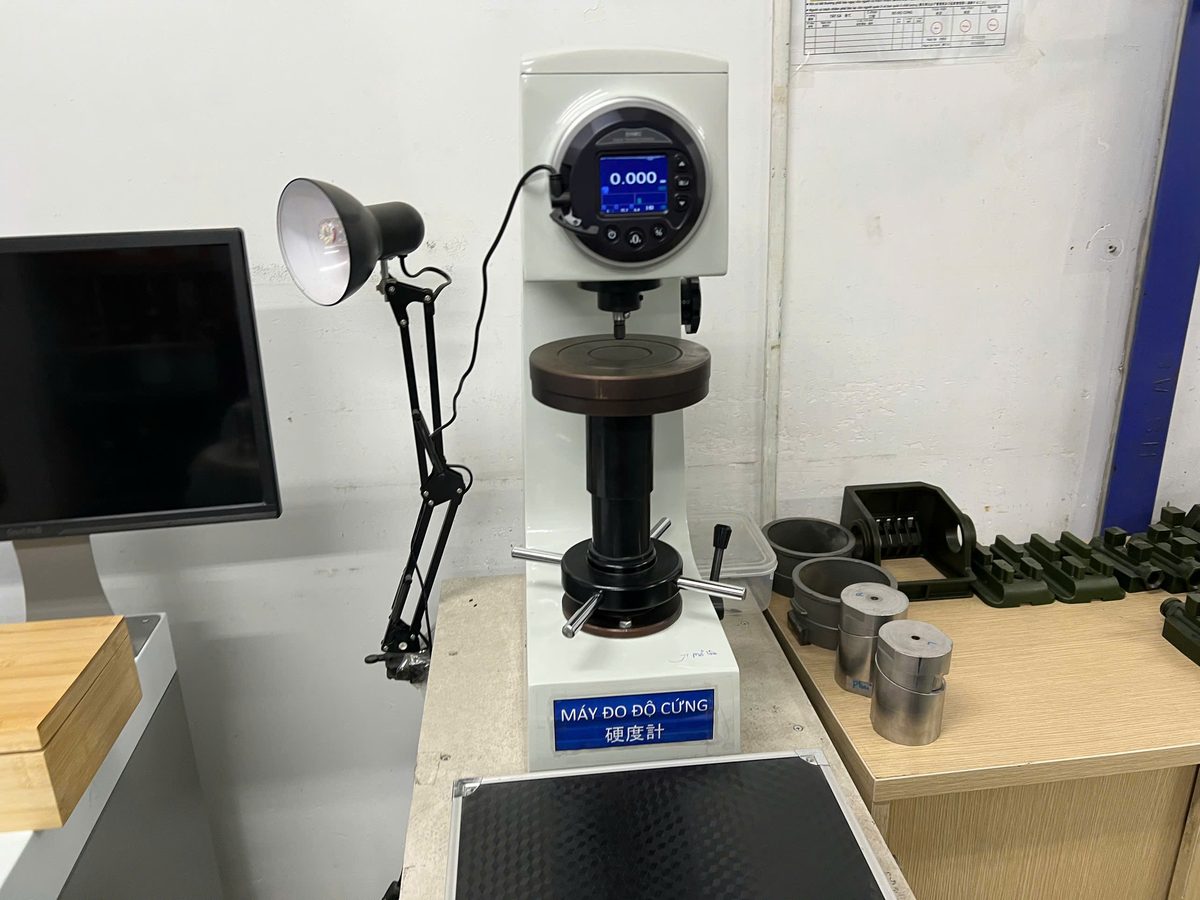
Hardness testing is the standard verification method for material grade confirmation and heat treatment result in cast metal components. At Kobayashi, the hardness testing machine is part of their standard outgoing inspection flow — not an on-demand or outsourced step.
What Hardness Testing Verifies on Investment Castings
| Verification Objective | Why It Matters | Scale Used |
|---|---|---|
| Alloy grade confirmation | Confirms cast material delivered the hardness range consistent with its specification (e.g., WCB carbon steel 137–187 HBW) | HBW (Brinell) |
| Heat treatment verification | Confirms post-cast thermal cycles (Q&T, precipitation hardening, solution anneal) were completed correctly — a part that tested soft after H900 treatment was not properly hardened | HRC (Rockwell C) |
| Batch consistency | Verifies hardness consistency across a production lot — statistical variation within acceptable range indicates controlled process, not isolated lucky samples | HBW or HRC |
For buyers sourcing structural castings, load-bearing brackets, wear-resistant components, or parts that require certified heat treatment, hardness verification is a non-negotiable acceptance criterion. Kobayashi's in-house capability means this check happens per lot, with records, as part of the shipment documentation package.
Dolphin Audit: 5-Pillar Results
DEWIN's 50-point Dolphin Audit is conducted on-site by our Vietnam-based team. Here are the results for Kobayashi Casting:
Pillar 1: Facility & Process Zone Control
✓ PassWax area, ceramic shell zone, pour area, finishing zone, and inspection zone visibly separated. Lot contamination prevention procedures in place. Ceramic slurry and refractory material storage organized. Furnace condition and temperature control reviewed. Zone discipline consistent with multi-batch production management.
Pillar 2: Wax Pattern Capability — In-House Confirmed
✓ Pass — Wax Injection In-HouseIn-house wax injection machine confirmed operational during audit visit. Wax material spec, injection parameter logging, die condition, and wax pattern dimensional check procedure assessed. In-house wax control verified as standard practice, not outsourced. Die maintenance records reviewed.
Pillar 3: Alloy & Material Traceability
✓ PassIncoming charge material documentation reviewed. Heat-to-batch traceability system confirmed — link between finished casting and melt batch maintained. Material Test Report (MTR) generation capability for alloy composition confirmed. Heat treatment batch records reviewed for applicable alloys. No un-documented secondary materials observed.
Pillar 4: Inspection — Hardness Testing Verified On-Site
✓ Pass — Hardness Tester PresentIn-house hardness testing machine confirmed with current calibration status. Hardness testing integrated into standard outgoing inspection routine per lot — not only on special order. Dimensional inspection procedures (caliper, gauge) reviewed. Visual defect classification system documented (porosity, shrinkage, cold shut, misrun, surface inclusion classification). Inspection records per lot reviewed.
Pillar 5: Documentation & COO Capability
✓ PassLot records and heat records maintained. Material Test Report (MTR/Mill Certificate) issuance procedure confirmed. Certificate of Conformance (CoC) capability verified. Certificate of Origin documentation capability: VCCI Form B (US MFN), CPTPP CO, RCEP CO, EVFTA Form EUR.1. Anti-circumvention documentation reviewed for compliance with origin rules.
FTA Market Access: 16+ Free Trade Agreements Covering Vietnam
Vietnam's FTA network gives Kobayashi Casting buyers preferential tariff access to major markets globally — but only when proper Certificate of Origin documentation is in place. Kobayashi's Dolphin Audit Pillar 5 confirmed their COO documentation capability across all major markets.
CPTPP
Canada, Australia, Japan, Mexico, NZ, Chile — progressive tariff elimination
EVFTA
EU 27 countries — significant tariff reductions on steel and stainless components
RCEP
China, Japan, South Korea, ASEAN — world's largest trade bloc by GDP
UKVFTA
United Kingdom — bilateral FTA with tariff preferences on manufactured goods
For EU buyers, the EVFTA provides meaningful tariff reduction on stainless steel castings (HS 73.25) and steel mechanical assemblies (HS 84.xx). For Japanese buyers, CPTPP enables preferential sourcing from Vietnam into Japan at reduced duty versus China-origin goods. For Korean buyers, the VKFTA provides bilateral tariff concessions.
These FTA advantages are not automatic — they require a supplier with verified COO documentation capability, which most Vietnam online sourcing listings cannot prove. DEWIN's Dolphin Audit Pillar 5 verifies COO documentation for every factory in the network.
DEWIN vs. Unverified Vietnam Investment Casting Supplier
| Factor | DEWIN — Kobayashi Casting | Unverified Online Listing |
|---|---|---|
| Factory site visit & audit | ✓ 50-point Dolphin Audit, on-site | ✗ Self-reported profile only |
| Wax injection capability verified | ✓ Confirmed in-house on audit visit | ~ Claimed but not verified |
| Hardness testing verified | ✓ Confirmed operational, calibration checked | ~ Often outsourced to 3rd-party lab |
| COO / FTA documentation | ✓ Audited in Dolphin Pillar 5 | ~ Varies — often inadequate or delayed |
| Real factory photos | ✓ 5 actual site-visit photos | ✗ Often stock or borrowed imagery |
| Vietnamese-language factory liaison | ✓ DEWIN team communicates natively | ✗ Buyer manages directly in English |
How to Source Investment Castings from Kobayashi via DEWIN
- Submit your enquiry — Share your 2D drawing (PDF) or 3D STEP file, alloy specification, heat treatment requirement, annual volume, and inspection requirements (hardness, MTR, FAI, etc.). DEWIN manages all factory communication in Vietnamese.
- DFM review — Our Vietnam engineering team reviews your drawing for investment casting DFM: wall thickness, draft, gating, machining allowance, and achievable tolerance and surface finish. Recommendations provided before tooling begins.
- Wax die tooling — Wax injection dies produced (typically 4–8 weeks standard geometry). DEWIN monitors tooling with factory visits and provides real-photo progress updates.
- First Article Inspection — First castings dimensionally inspected, hardness tested (if specified), and reviewed. FAI report sent to buyer for approval before production release.
- Production & in-process QC — DEWIN Vietnam team conducts in-process visits. Per-lot hardness records and dimensional records attached to each shipment documentation.
- Pre-shipment inspection & COO — Final visual and dimensional check by DEWIN QC team. Material Test Reports (MTRs) and Certificate of Origin issued for applicable markets (CPTPP, EVFTA, RCEP, UKVFTA, US MFN Form B).
Source Precision Investment Castings from Vietnam
Kobayashi Casting is one of 179+ audited factories in the DEWIN Vietnam network — with in-house wax injection, hardness testing, and full FTA documentation capability. Send us your drawing and we'll confirm fit and generate a quote from our verified network.